'%3e%3cpath%20d='M706.453%20375.999C860.234%20375.999%20984.899%20291.829%20984.899%20188C984.899%2084.1703%20860.234%200%20706.453%200C552.671%200%20428.006%2084.1703%20428.006%20188C428.006%20291.829%20552.671%20375.999%20706.453%20375.999Z'%20fill='%23009B4F'/%3e%3cpath%20d='M278.447%20375.999C432.229%20375.999%20556.893%20291.829%20556.893%20188C556.893%2084.1703%20432.229%200%20278.447%200C124.665%200%200%2084.1703%200%20188C0%20291.829%20124.665%20375.999%20278.447%20375.999Z'%20fill='%23009B4F'/%3e%3cpath%20d='M141.484%20166.68C125.01%20162.158%20114.996%20158.927%20114.996%20150.529C114.996%20143.422%20122.102%20138.9%20133.085%20138.9C144.068%20138.9%20155.051%20143.099%20164.095%20150.529L164.418%20150.852L165.388%20129.855C156.666%20125.01%20147.944%20121.78%20133.731%20121.78C123.394%20121.78%20114.027%20124.364%20107.243%20129.209C99.8137%20134.378%2095.9374%20142.13%2095.9374%20151.175C95.9374%20168.941%20110.796%20176.694%20123.394%20179.924C140.192%20184.446%20151.821%20188.323%20151.821%20198.659C151.821%20207.381%20144.068%20212.872%20131.47%20212.872C118.872%20212.872%20106.274%20207.381%2096.5834%20198.013L96.2604%20197.69L94.3223%20219.979C104.336%20226.762%20116.934%20230.316%20130.501%20230.316C142.13%20230.316%20152.144%20227.408%20159.25%20221.917C167.003%20216.103%20171.202%20207.704%20171.202%20197.367C171.202%20181.862%20161.511%20171.848%20141.484%20166.68Z'%20fill='white'/%3e%3cpath%20d='M264.557%20188C264.557%20215.78%20246.467%20230.316%20225.471%20230.316C215.457%20230.316%20207.381%20226.762%20201.244%20221.271V253.896H182.186V146.976H201.244V156.02C207.704%20149.883%20216.103%20145.684%20226.763%20145.684C247.436%20145.36%20264.557%20160.22%20264.557%20188ZM245.498%20188C245.498%20172.494%20236.131%20162.158%20222.887%20162.158C214.811%20162.158%20207.058%20165.711%20201.567%20173.787V203.182C207.058%20210.288%20214.488%20213.841%20222.887%20213.841C236.131%20213.841%20245.498%20203.505%20245.498%20188Z'%20fill='white'/%3e%3cpath%20d='M352.095%20194.137H294.274C296.535%20207.058%20305.903%20213.841%20318.824%20213.841C329.807%20213.841%20337.882%20211.257%20346.604%20206.089L347.573%20222.886C339.82%20227.085%20330.13%20230.316%20317.532%20230.316C294.274%20230.316%20274.893%20215.78%20274.893%20188.323C274.893%20162.804%20294.274%20145.683%20317.209%20145.683C341.112%20145.683%20353.71%20160.22%20353.71%20181.216C353.71%20185.415%20353.064%20189.615%20352.095%20194.137ZM335.621%20178.632C335.621%20168.618%20329.161%20160.866%20317.532%20160.866C306.549%20160.866%20296.858%20168.295%20294.597%20180.893H335.298C335.621%20180.247%20335.621%20179.601%20335.621%20178.632Z'%20fill='white'/%3e%3cpath%20d='M443.189%20221.917L445.128%20203.505C452.88%20209.965%20463.54%20213.841%20474.846%20213.841C482.921%20213.841%20488.413%20210.611%20488.413%20204.797C488.413%20189.615%20444.482%20197.367%20444.482%20169.91C444.482%20153.436%20458.695%20145.36%20475.492%20145.36C487.444%20145.36%20496.488%20148.268%20503.272%20152.467L502.303%20169.587C494.227%20164.096%20484.213%20161.189%20475.492%20161.189C468.708%20161.189%20463.217%20163.773%20463.217%20168.941C463.217%20181.862%20507.471%20175.402%20507.471%20203.828C507.471%20221.271%20492.289%20229.993%20474.523%20229.993C461.602%20230.316%20450.942%20227.085%20443.189%20221.917Z'%20fill='white'/%3e%3cpath%20d='M590.488%20177.986V228.701H571.429V220.302C564.969%20226.439%20556.57%20229.993%20546.88%20229.993C528.467%20229.993%20517.484%20219.01%20517.484%20203.505C517.484%20187.03%20530.405%20177.017%20549.464%20177.017C556.57%20177.017%20563.677%20178.309%20571.752%20180.57V177.986C571.752%20165.388%20562.385%20159.897%20550.756%20159.897C542.034%20159.897%20532.02%20163.127%20524.914%20168.941L524.268%20152.467C530.405%20148.268%20541.711%20145.037%20554.309%20145.037C574.983%20145.36%20590.488%20155.374%20590.488%20177.986ZM571.429%20206.735V194.46C564.646%20192.199%20558.185%20190.907%20551.402%20190.907C541.711%20190.907%20535.574%20196.075%20535.574%20203.505C535.574%20210.934%20542.034%20215.78%20550.433%20215.78C558.508%20215.78%20564.969%20212.872%20571.429%20206.735Z'%20fill='white'/%3e%3cpath%20d='M592.104%20146.976H612.777L636.358%20198.659L659.616%20146.976H680.289L641.526%20228.701H630.866L592.104%20146.976Z'%20fill='white'/%3e%3cpath%20d='M754.907%20194.137H697.409C699.67%20207.058%20709.038%20213.841%20721.959%20213.841C732.941%20213.841%20741.017%20211.257%20749.739%20206.089L750.708%20222.886C742.955%20227.085%20733.264%20230.316%20720.667%20230.316C697.409%20230.316%20678.027%20215.78%20678.027%20188.323C678.027%20162.804%20697.409%20145.683%20720.343%20145.683C744.247%20145.683%20756.845%20160.22%20756.845%20181.216C756.522%20185.415%20756.199%20189.615%20754.907%20194.137ZM738.756%20178.632C738.756%20168.618%20732.295%20160.866%20720.667%20160.866C709.684%20160.866%20699.993%20168.295%20697.732%20180.893H738.433C738.433%20180.247%20738.756%20179.601%20738.756%20178.632Z'%20fill='white'/%3e%3cpath%20d='M826.618%20148.914L824.034%20166.357C819.511%20163.773%20814.989%20163.127%20810.467%20163.127C802.068%20163.127%20794.315%20167.326%20788.824%20176.371V228.701H769.766V146.976H788.824V157.958C794.315%20150.529%20802.068%20145.36%20812.728%20145.36C817.896%20145.36%20822.418%20146.653%20826.618%20148.914Z'%20fill='white'/%3e%3cpath%20d='M832.109%20221.917L834.048%20203.505C841.8%20209.965%20852.46%20213.841%20863.766%20213.841C871.841%20213.841%20877.333%20210.611%20877.333%20204.797C877.333%20189.615%20833.401%20197.367%20833.401%20169.91C833.401%20153.436%20847.615%20145.36%20864.412%20145.36C876.364%20145.36%20885.408%20148.268%20892.192%20152.467L891.223%20169.587C883.147%20164.096%20873.133%20161.189%20864.412%20161.189C857.628%20161.189%20852.137%20163.773%20852.137%20168.941C852.137%20181.862%20896.391%20175.402%20896.391%20203.828C896.391%20221.271%20881.209%20229.993%20863.443%20229.993C850.522%20230.316%20839.862%20227.085%20832.109%20221.917Z'%20fill='white'/%3e%3cpath%20d='M429.298%20206.412C422.838%20211.257%20416.054%20213.841%20408.302%20213.841C395.058%20213.841%20383.429%20204.474%20383.429%20188C383.429%20171.525%20395.058%20162.158%20408.302%20162.158C416.054%20162.158%20422.838%20164.742%20429.298%20169.264C430.268%20163.45%20431.237%20157.958%20432.852%20152.467C426.068%20148.591%20417.67%20145.683%20406.041%20145.683C382.783%20145.683%20363.725%20161.512%20363.725%20188C363.725%20214.487%20382.783%20230.316%20406.041%20230.316C417.67%20230.316%20426.068%20227.085%20432.852%20222.886C431.237%20217.395%20429.944%20211.903%20429.298%20206.412Z'%20fill='white'/%3e%3c/g%3e%3cdefs%3e%3cclipPath%20id='clip0_1478_9029'%3e%3crect%20width='984.9'%20height='375.999'%20fill='white'/%3e%3c/clipPath%3e%3c/defs%3e%3c/svg%3e)
1 of 3
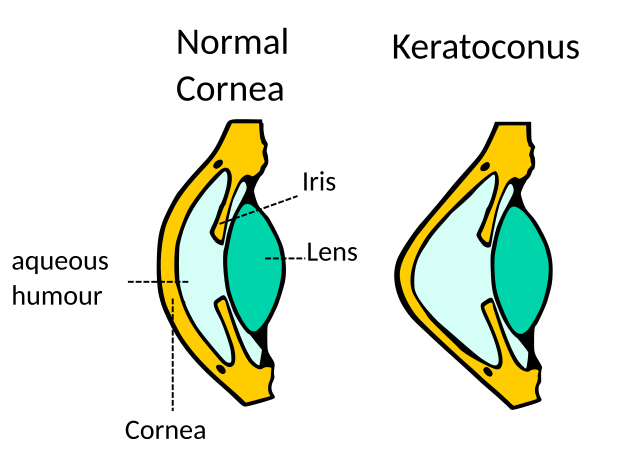
Healthy cornea
The cornea is rounded and smooth.
2 of 3
Keratoconus cornea
Rather than being rounded, the cornea becomes cone shaped.
3 of 3
Scarring
Over time, damage to the weakened cornea can cause scarring.
Keratoconus is when the cornea (the transparent layer on the front of your eye) gets thinner and starts bulging out into a cone shape. Rather than being round like a football, the front of the eye becomes more pointed, like a rugby ball.
Here’s how keratoconus changes the eye’s shape and vision.
The symptoms of keratoconus symptoms change from one person to the next, depending on how advanced it is. For some people, it develops quite rapidly, while for others it progresses more slowly over years or even decades.
Symptoms typically start in your early teenage years through to your early twenties, though they can begin earlier or later.
Any change in your vision should be checked by an optometrist as soon as possible.
Here are some of the main keratoconus symptoms, depending on the stage.
The first symptoms of keratoconus are changes in your vision. However, these changes might not always be obvious, and it can be mistaken for other conditions. Early stage symptoms include:
As the cornea starts to change shape, light passing through to the back of the eye doesn't get focused as well, causing blurring.
Learn more about blurry vision
Some parts of your vision are clear, but other parts become blurry. You might get some double vision too.
Learn more about double vision
You might notice that you become more sensitive to light. Bright lights can feel uncomfortable to look at, as can sunlight.
People with keratoconus often notice they develop short‑sightedness (myopia), meaning they can't see things further away as clearly.
Learn more about short‑sightedness
This when you get blurred or distorted vision caused by an irregular eye shape. It can mean you have difficulty seeing at night or in low‑light conditions.
Learn more about astigmatism
If you find that you regularly need to change your prescription glasses or contact lenses, this could be a sign of keratoconus.
Book an eye testHere are some of the signs of more advanced stages of keratoconus:
In later stages of keratoconus, the cornea appears more pointed or cone shaped, instead of being rounded with a smooth curve.
As keratoconus develops, you may notice there are multiple 'ghost' images that surround a main image when looking at things (known as 'monocular polyopia'). These can appear scattered randomly around the main image. Over time, the way these 'ghost' images appear can change.
Over time, your vision may get significantly worse, with blurriness, distortion, or cloudiness making it more difficult to see clearly.
Learn more about cloudy vision and blurry vision
As your cornea gets thinner, it can be more easily damaged. This can cause scarring on the cornea, which can make vision blurrier.
Learn more about corneal abrasion
Since your cornea has changed shape so much, it can become almost impossible to place normal contact lenses over the cornea.
While keratoconus isn't usually painful, it can cause discomfort, throbbing, a gritty feeling or even a burning sensation for some people.
Learn more about eye pain
People with keratoconus often experience "Ghosting". This is when multiple 'ghost' images appear around the main object they're looking at (particularly when viewing high contrast images). These 'ghosts' tend to be scattered around the main image at random.
Book an eye test
Keratoconus can progress through four stages ‑ mild, moderate, advanced, and severe. It develops differently for each person. Some people's keratoconus never progresses beyond the mild stage, while for others it can develop to more advanced stages within a few years. In most cases, progression slows or stops by your 30s or 40s.
If you have keratoconus, regular eye exams with your optometrist are essential. They can monitor any changes and help manage the condition.
Your cornea starts to become thinner and bulges a little. You will experience some problems seeing things further away and some blurring. You may also notice you're more sensitive to light.
Your cornea becomes more cone‑like in shape. This is known as corneal steepening. There may be some scarring of the cornea, and the blurring and visual distortion is more noticeable.
At the advanced stage, your cornea protrudes more visibly, it becomes thinner and there is scarring. You'll notice more blurring, visual distortions (multiple 'ghost' images) and other symptoms.
Cornea becomes very thin and bulges outwards. Vision is often badly affected, with blurring and distortion. In some cases, a split can develop in the back layer of the cornea (called hydrops), causing painful swelling and scarring.
Book an eye testBeing diagnosed with keratoconus can be very concerning. The good news is that there are many effective keratoconus treatments available. Treatment depends on how advanced the condition is and your symptoms. Our optometrists have lots of experience with keratoconus in Australia, and can walk you through your options.

Optometrists still don't know exactly why keratoconus happens ‑ it's likely to be a mix of things coming together. Here are some of the main keratoconus causes that experts believe contribute to the condition.
There is evidence that there is a genetic element to keratoconus ‑ it often runs in families. It is also more common in people who have certain genetic conditions, like Down syndrome.
People who rub their eyes a lot are more likely to develop keratoconus as this can damage the cornea. People with allergies, eye infections, dry eye syndrome, or eczema may rub their eyes more often.
Learn more about dry eye syndrome
Keratoconus appears to be connected to hormonal changes (hormones are your body’s chemical messengers). Symptoms often begin around puberty as well as other times of rapid hormonal change, like pregnancy or menopause.
Some environmental factors, such as pollen, high levels of ultraviolet light or even air pollution could be possible keratoconus causes.
All kinds of people get keratoconus in Australia, but some people seem to be more affected than others. It's more common among young people ‑ it often begins during puberty or in people's early twenties. It also seems to affect people from Asian (and particularly South Asian) backgrounds more than people from other ethnicities, according to research.
If you believe you might have keratoconus eye or you've noticed changes in vision that could be caused by it, it’s important to see your optometrist. They will do tests to work out what’s going on. The earlier you get diagnosed, the more your optometrist can do to manage the condition ‑ or even stop it from getting worse.
Your optometrist will ask about when the symptoms began, what things look like for you, and if you notice any patterns (such as times of day it's more noticeable). They will also want to know if any of your relatives have similar issues ‑ it's worth asking around your extended family.
Your optometrist will do some tests to check for short‑sightedness or astigmatism. They will ask you to read off a Snellen chart, where the letters go from large to small.
Learn more about snellen charts
A slit lamp is a powerful microscope with a light attached that lets the optometrist see your cornea very close up.
Learn more about slit lamps
A retinoscope lets the optometrist check how well your eyes focus. It helps the optometrist work out how short‑ or long‑sighted you are.
Learn more about retinoscopes
This is a special device that measures the curve of your cornea. It can be really helpful for seeing how your keratoconus is advancing.
Learn more about keratometers
This powerful machine helps optometrists view the inside of your eye and can help monitor changes in shape over time.
Learn more about OCT scans
Most people with keratoconus can manage the condition well and there are several treatment options depending on how advanced it is. At Specsavers, we focus on helping you see clearly and comfortably. Your optometrist will talk through the right option for you, based on how far your keratoconus has progressed, your age, and your overall eye health.
If your keratoconus is fairly mild, your optometrist may advise wearing prescription glasses. These will help treat astigmatism or short‑sightedness, making it easier for you to see things.
Learn more about glasses
Another option for mild keratoconus is to use standard contact lenses. Again, these help with astigmatism and short‑sightedness.
Learn more about contact lenses
RGP contact lenses are made of a rigid breathable plastic that creates a tear layer the shape of the cornea. This corrects it to fit the natural shape of the lens. These hard contact lenses for keratoconus are easy to put in and take out, though they may take a little getting used to at first.
A scleral lens is a large, made‑to‑measure lens that sits on the sclera (the whites of your eyes), rather than on your cornea. Since your sclera is less sensitive than your cornea, these lenses can be more comfortable for people with keratoconus.
Piggybacking is when you wear a pair of soft contact lenses underneath a hard RGP lens. It can help to prevent the rigid RGP lens from irritating the surface of your cornea.
Because keratoconus is often caused (or exacerbated) by excessive eye rubbing, your optometrist may recommend ways to change this behaviour. If allergies are making you rub your eyes, medication might help. For dry eye syndrome, using artificial tears could be beneficial.
Learn more about hay fever and dry eye syndrome
This hospital treatment helps to stop keratoconus from getting worse. It uses vitamin B2 eye drops and ultraviolet light to strengthen the cornea. If your optometrist thinks it could help, they’ll refer you to an eye specialist for assessment and treatment.
In some cases, where the cornea is very thin or scarred, surgery may be needed. This could involve laser treatment to reshape the cornea or a transplant to replace it. Your optometrist will explain your options and refer you to an eye hospital if needed.
Book an eye testIt's not always possible to prevent keratoconus ‑ some of the things that cause it (like genetics or hormonal changes) are out of your control. But there are some things you can do to reduce your risk.
Most importantly, you should avoid excessive eye rubbing, since this can make the cornea weaker and thinner. You can also reduce exposure to environmental factors too. For example, wearing UV protected sunglasses reduces the effects of UV radiation. Staying away from things that cause allergies or taking antihistamines can also help.
Having regular eye examinations can also help catch the condition early, and potentially stop it from progressing.
In the early stages, your optometrist will usually recommend using contact lenses or glasses for keratoconus. If the condition continues to progress, referral to a corneal specialist will be required to consider further treatment options, depending on the severity of the keratoconus.
No, not exactly. Depending on your symptoms and stage of keratoconus, your optometrist might advise wearing glasses for myopia (short‑sightedness) or astigmatism (irregular eye surface). They'll recommend the right glasses depending on your symptoms and needs.
For most people, keratoconus stabilises by the time they reach their 30s or 40s. If it's treated and you see your optometrist regularly, it may not progress beyond mild stages. However, it can still progress to more severe stages ‑ and this can cause significant vision loss and sight problems.
It’s very unlikely that keratoconus will cause blindness – only in very rare cases does it lead to serious vision problems. However, the condition can worsen enough to interfere with daily activities due to reduced vision.
It’s not always clear why one person develops keratoconus, but another doesn't. This can feel really frustrating and unfair. Experts believe that it happens when a number of factors come together, including genetics, environmental factors, and behavioural habits (such as excessive eye rubbing).
Yes, most people lead a normal life with keratoconus in Australia. If you are receiving treatment with glasses or contact lenses, you should be able to carry on doing all the normal things you'd like to do. However, if it goes untreated or progresses rapidly, it could make your vision much worse, meaning everyday activities (from playing sports to reading to watching TV or driving) become much harder. This is why it's important to have regular eye checks if you have keratoconus.
Possibly. There is some evidence that keratoconus seems to run in families (around 1 in 10 people with the condition have a parent who also has it). If you have keratoconus, it could therefore increase your child's chance of having it, but we don't yet know how much of a role genes play. It also depends on their other parent's genes ‑ your child simply might not inherit the keratoconus gene from you. Many other non‑genetic factors also play a big part in keratoconus ‑ such as hormonal imbalances, environment, and eye rubbing.
Eye tests are bulk billed to Medicare, so there are no out‑of‑pocket expenses for you*.

Keratoconus Australia (2025) Keratoconus. Available at: https://www.keratoconus.org.au/
Lions Eye Institute (2025) Keratoconus. Available at: https://www.lei.org.au/services/eye‑health‑information/keratoconus/
Loukovitis, E., et al (2018) Genetic Aspects of Keratoconus: A Literature Review Exploring Potential Genetic Contributions and Possible Genetic Relationships with Comorbidities. Available at: https://pmc.ncbi.nlm.nih.gov/articles/PMC6258591/
Mayo Clinic (2025) Keratoconus. Available at: https://www.mayoclinic.org/diseases‑conditions/keratoconus/symptoms‑causes/syc‑20351352
Omer, K. (2018) Epidemiology of Keratoconus Worldwide. Available at: https://www.sciencedirect.com/org/science/article/pii/S1874364118000450
Review of Optometry (2024) New Evidence Strengthens the Link Between Air Pollution and Keratoconus. Available at: https://www.reviewofoptometry.com/news/article/new‑evidence‑strengthens‑the‑link‑between‑air‑pollution‑and‑keratoconus
Cloudy, misty or blurred vision could be a sign of cataracts, particularly in bright conditions or at night.
Astigmatism means the cornea has an uneven shape, which can blur your vision at all distances.
Long‑sightedness, or hyperopia, means you can see things in the distance more clearly than close up.
Myopia, or short‑sightedness, means you can see nearby objects clearly, but distant ones are blurry.
Glaucoma is an eye condition that can damage your optic nerve and cause vision loss if it isn’t picked up early.
If you have diabetes, it’s important to watch out for diabetic retinopathy which can cause vision changes.
Vision that looks misty or hazy could be a sign of cataracts or another eye issue that needs checking.
Double vision means seeing two images of a single object, which can happen when the eyes are not aligned or working together properly
Do your eyes feel sore, tried or gritty? Dry eye could be the cause, making vision cloudy, or as if you have filmy eyes.
This is when the edges of your eyelids become inflamed due to an infection. It can also make the whites of your eyes appear pink or red.
Learn more about blepharitis
Seeing specks, spots or sudden flashes of light? These are common – but can also be a sign of a serious eye condition. It is worth checking out if they’re new or getting worse.
A chalazion is a blocked oil gland in the eyelid that causes a firm, usually painless lump and can lead to eyelid swelling or blurred vision.
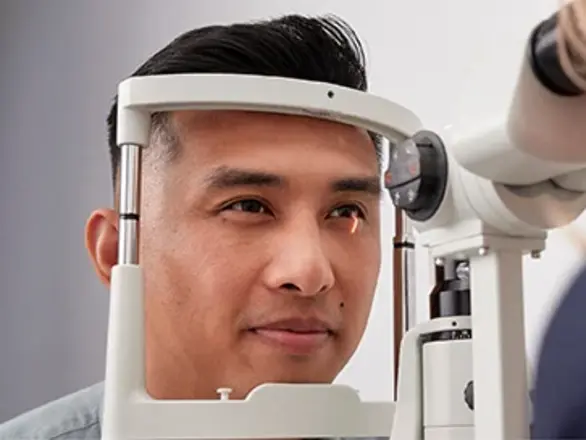
Eye tests play a huge part in making sure your eyes stay healthy.
Check your vision
At Specsavers we are focused on caring for your eyes and giving you the best possible vision.
What to expect in‑store
An eye test is not just about getting glasses – it is a vital health check for your eyes.
All about eye tests* Listed on a valid Medicare card without Optometry restrictions.